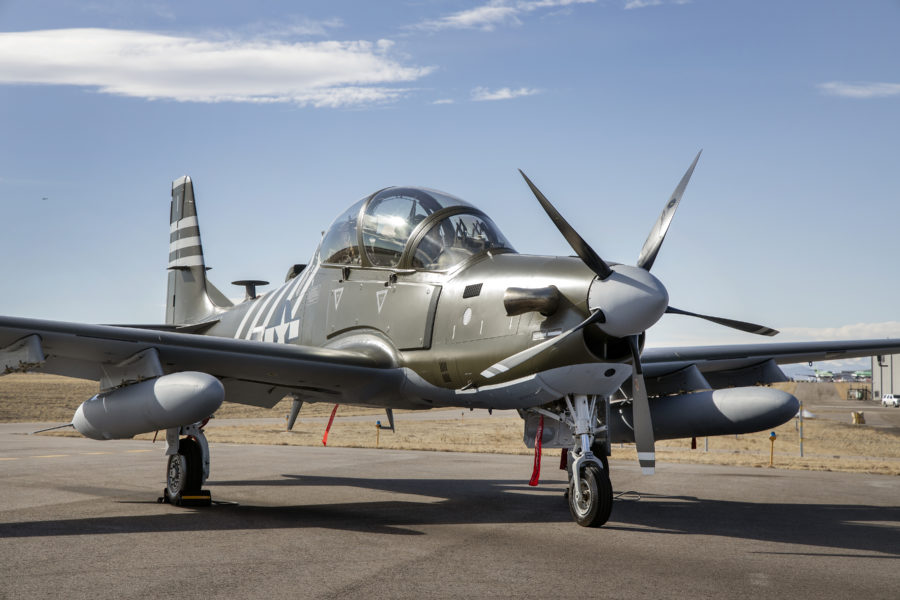
SNC MOVES FOR JUDICIAL REVIEW OF CDI

SPARKS, Nev., April 17, 2012 -- Sierra Nevada Corporation (SNC) filed a motion with the United States Court of Federal Claims April 16 asking for judicial review of the results of the Commander Directed Investigation (CDI) in the still-pending lawsuit filed by Hawker Beechcraft Defense Company (HBDC) against the U.S. Air Force.  The lawsuit resulted in the USAF setting aside the Light Air Support (LAS) contract previously awarded to SNC and opening a Commander Directed Investigation into the source selection process.  The Air Force announced April 13 that Part 1 of the CDI was completed.  SNC's motion seeks court review of Part 1 of the CDI to allow the judge to have all the relevant facts available to make a fair and expeditious decision on the way forward in the lawsuit.  

"We believe it is important to the goals of transparency, a fair and open competition and the integrity of the process that the Court now review the results of the Air Force investigation and actions, including determining whether the agency's proposed corrective actions were justified and reasonable," said SNC Taco Gilbert, Vice President of ISR Business Development at SNC.  "The results of the CDI, after all, speak to the very core of the litigation brought by Hawker Beechcraft. If this matter can be expeditiously resolved through the court, it is better for American taxpayers, U.S. jobs, our military men and women, our partner nations and for our nation's security."

Hawker Beechcraft sued the US Air Force in December 2011 after being disqualified from the LAS competition for failure to adequately correct deficiencies in its proposal and because its plane was found technically deficient and presented "unacceptable mission capability risk." It asked the Court to review the selection process surrounding the USAF decision to disqualify HBDC from the LAS competition and subsequently award the LAS contract to SNC. 

"At the time the Air Force took its corrective action, neither the Judge nor the parties had full insight into the initial basis for the Air Force's dissatisfaction with the documentation supporting the source selection decision-making process.  Now that material information exists on this pivotal issue, it is in the best interest of all parties that it be reviewed as a part of Hawker Beechcraft's continuing lawsuit.  The Federal Claims Court also is the appropriate forum for this review as it is subject to a protective order and will protect proprietary source selection information," Gilbert said. 

###


SIERRA NEVADA CORPORATION URGES US AIR FORCE TO CONCLUDE LAS COMPETITION SWIFTLY, BASED ON SUBSTANTIAL WORK ALREADY DONE 

USAF Clarifies Investigation of LAS Contract Award Focused on Internal Issues

SPARKS, NV, March 7, 2012 – Sierra Nevada Corporation (SNC) today called on the United States Air Force (USAF) to move expeditiously to select an aircraft for its Light Air Support (LAS) Program.

Specifically, the company urges the USAF to issue a plan and timeline for moving forward with the selection process, make use of the substantial information received under its original source selection, and maintain the high standards for aircraft performance in the original Request for Proposal (RFP) that were based on the unique requirements of the LAS mission.  

The company also said it received clarification from the USAF that its investigation of the LAS contract award is focused on USAF paperwork issues and not the actions of either of the offerors in the competition.  According to Air Force Spokeswoman Jennifer L. Cassidy, “The Air Forces agreed to take corrective action and suspend the Light Air Support contract awarded to Sierra Nevada Corporation because the Air Force Senior Acquisition Executive, David Van Buren, was not satisfied with the quality of the documentation supporting the award decision.  This documentation issue was internal to the Air Force and is not the result of actions of any offeror.  The Air Force has initiated a Commander Directed Investigation (CDI) to look at internal acquisition policies and procedure.”  

Given the current situation – a USAF review that is limited to internal processes, a looming deadline to get the LAS aircraft into service in Afghanistan, and more than 14 months already spent assessing the competing aircraft – SNC and its partners believe there is no reason the USAF should not now move quickly to put forward a plan for an expedited review process.  

“We appreciate that mistakes happen and that the Air Force has taken a firm stance to maintain the integrity of their acquisition process.  However, we are also aware that this is the second time the Department of Defense has been frustrated in attempts to send this capability to Afghanistan,” said Taco Gilbert, Ret. USAF Brigadier General, and Vice President of ISR Business Development at SNC, referring to the cancellation of Operation Imminent Fury. “There are men and women from the United States and our allies engaged in combat operations everyday that have called for this capability.”  Currently, all fixed-wing combat power in Afghanistan is supplied by the US and other allies. 

“One of my principal concerns is that there will be an effort to lower the system requirements for the LAS competition, which would jeopardize the mission,” Gilbert said. “That would mean combat forces would be saddled with an aircraft that has been determined to be ‘technically insufficient’ and that carries ‘unacceptable capability risk.’”

“The stakes are high.  The operational imperative is to get a LAS capability to Afghanistan quickly to transition security responsibilities and a redeployment of U.S. forces elsewhere. There is also a need to preserve the significant taxpayer dollars and countless hours already spent evaluating the two competing aircraft,” Gilbert said.  “Rewriting the RFP to a lower set of standards or starting the competition over at this point would endanger these goals.”  

“Given the word from the Air Force, SNC and our partners are ready to move in extremely rapid fashion,” Gilbert said, adding, “at this point in the process, Hawker Beechcraft should be ready to do the same. Their reasons for standing in the way of this process no longer exist.” 

# # #


Letter From Rep. Allen B. West to Michael B. Donley, Secretary of the Air Force

February 29, 2012

   Download PDF Version of Letter

Statement of Taco Gilbert, Ret. USAF Brigadier General, and Vice President of ISR Business Development for Sierra Nevada Corporation on U.S. Air Force Decision to Set Aside Award of Light Air Support Contract

SPARKS, Nevada, Feb. 28, 2012 -- Taco Gilbert, Ret. USAF Brigadier General, and Vice President of ISR Business Development at Sierra Nevada Corporation (SNC) issued the following statement in response to the announcement by the U.S. Air Force that it will set aside the contract issued in December for Light Air Support capabilities (LAS):

"We are disappointed by this decision.  We offered the U.S. Air Force a fully proven and cost-effective Light Air Support solution – and one that would be made in America, create and support American jobs and result in economic investment in the U.S.  We know that our submission fully met the requirements of the U.S Air Force Request for Proposal (RFP) and that Sierra Nevada Corporation fully complied with the RFP process as set out by the U.S. Air Force.

"Today's announcement only further delays the effort to get critical capabilities into the hands of our men and women in uniform and our coalition partners in-theatre.  It also stymies efforts to create jobs and economic development at a time when our economy needs the boost.

"SNC and our team remain ready to get to work on this important contract. The A-29 Super Tucano, made in America, is the only plane that is capable today of meeting the requirements of the LAS mission. Nothing changes the fact that the war-fighter needs this capability immediately."

###


SIERRA NEVADA CORPORATION EXPLORING OPTIONS TO MITIGATE DELAYS IN MEETING APRIL 2013 DELIVERY DATE FOR LAS AIRCRAFT

SPARKS, NV, February 15, 2012 – Sierra Nevada Corporation (SNC) today announced that it is exploring ways to mitigate delays in meeting the April 2013 delivery schedule for the first aircraft called for under United States Air Force Light Air Support (LAS) contract.   SNC was awarded that contract in late December, but due to a lawsuit filed by the disqualified competitor for the contract, has been prevented from initiating work.  In a briefing paper issued in late January, the Air Force acknowledged that it expected delivery of the aircraft to be delayed due to the current litigation.

The aircraft to be provided is the Embraer A-29 Super Tucano.  It will be used in Afghanistan to conduct advanced flight training, aerial reconnaissance and light air support operations.  It is integral to U.S. plans to provide the Afghanistan government with an indigenous advanced training and combat capable aircraft to facilitate that country’s internal security capability.

In an article published Jan. 15, Brig. Gen. Tim Ray, the NATO Air Training Command-Afghanistan commander, called the A-29 Super Tucano "tailor made" for the Afghan's counterinsurgency mission. "The Tucano is the most kinetic, most offensive aircraft they'll have, and I'm sure a big morale boost to the troops on the ground when they see it overhead. It's the right kind of platform for the terrain, the fight and most importantly, it's easy to sustain," he said.

“We recognize the importance of this aircraft to successfully ending the U.S. mission in Afghanistan,” said Taco Gilbert, Ret. USAF Brigadier General, and Vice President of ISR Business Development at SNC.  “Given the stakes and given recent reports of a potentially accelerated end to U.S. combat operations there, we are looking at all possible options for speeding up our production and delivery timeline.  However, until the stop work order is lifted, we cannot make any movement in this regard.”

The U.S. Air Force issued a temporary stop work order January 4 in response to a lawsuit filed by Hawker Beechcraft in the U.S. Court of Federal Claims. That suit challenges Hawker’s elimination from the LAS competition.  The Air Force notified Hawker Beechcraft in November that its proposal was not in the competitive range and that it had been disqualified from the competition.  The Air Force based its determination on the finding that “multiple deficiencies [PDF] and significant weaknesses found in [Hawker Beechcraft’s] proposal make it technically unacceptable and results in unacceptable mission capability risk.” 

The A-29 Super Tucano is mission ready and combat proven.   It is currently in use with six air forces around the world, performing counterinsurgency and close air support operations.  The LAS aircraft will be made in America by American workers.  Embraer is investing millions of dollars in the development of a new military aircraft production facility in Jacksonville, FL, creating at least 50 new high tech jobs in the process.  More than 88 percent of the dollar value of the A-29 Super Tucano comes from components supplied by American companies or countries that qualify under the Buy America Act.  In all, more than 70 U.S. companies will supply parts or services related to this contract, supporting another 1,200+ jobs across the country.

“SNC, Embraer, and all of our team members are committed to the LAS mission and to bringing a successful close to U.S. operations in Afghanistan,” Gilbert said.  “However, this will only happen if we can equip the Afghanis with the tools and training they need to develop their own counterinsurgency capability.  We are looking at how we can speed up our process; we hope that there will be a swift resolution to the litigation and an end to unnecessary delays of this critical program.”

# # #

SIERRA NEVADA CORPORATION CORRECTS THE RECORD ON U.S. AIR FORCE LIGHT AIR SUPPORT PROGRAM

Misinformation and Legal Wrangling Delaying Mission-Critical A-29 Super Tucano for American Warfighters in Afghanistan

SPARKS, NV, February 2, 2012 – Sierra Nevada Corporation (SNC), the winner of the U.S. Air Force Light Air Support (LAS) competition, today issued a point-by-point rebuttal of misinformation being spread by the disqualified contender for the contract. 

The LAS contract provides aircraft, training and support for the U.S. government’s partner building efforts in Afghanistan and other nations.  The aircraft is urgently needed to support aerial reconnaissance and light air operations in Afghanistan, as well as to develop the organic capability needed to complete the United State’s counterinsurgency mission in Afghanistan.  On Dec. 22, 2011, the U.S. Air Force awarded the LAS contract to SNC, having earlier disqualified the other contender for the contract, Hawker Beechcraft, as being not in the competitive range based on the finding that “multiple deficiencies and significant weaknesses found in [Hawker Beechcraft’s] proposal make it technically unacceptable and results in unacceptable mission capability risk.”  Since that time, Hawker Beechcraft has undertaken a massive misinformation campaign, challenged the integrity of the U.S. Air Force contracting process, questioned the intentions of the Obama Administration, and used litigation to stop work on the contract. 

“It is essential that the full facts of this situation are presented clearly and transparently to the American public.  There is too much at stake,” said Fatih Ozmen, CEO of Sierra Nevada Corporation.  “The people who are paying the price of this reckless and irresponsible behavior are the American taxpayer and the American warfighter.  Sierra Nevada Corporation and our partners are honored by this award and the opportunity to serve our country as we remain ready to get to work on the LAS contract.”

In its Request for Proposal, the Air Force specifically sought a non-developmental, in-production aircraft so that warfighters in-theater could have an advanced solution quickly and so that American taxpayers would not have to pay development costs. The plane proposed by SNC’s competitor is a developmental aircraft that is not in production and has never been used for light air support or any other purpose.

In contrast, the aircraft selected by the Air Force and to be provided by SNC, Embraer’s A-29 Super Tucano, is a light air support aircraft that is currently in use with six air forces around the world.  This aircraft will be made in America by American workers.  More than 88 percent of the dollar value of the A-29 Super Tucano comes from components supplied by American companies or countries that qualify under the Buy America Act.  The aircraft will be built in Jacksonville, Florida creating at least 50 new high tech jobs and supporting another 1,200+ jobs across the country. 

“It’s unfortunate that the truth is being sacrificed for the self interests of Hawker Beechcraft and its owners a Canadian company, Onex, and an investment bank, Goldman Sachs.  Hawker Beechcraft is using aggressive media and lobbying tactics to fight the Air Force decision instead of letting the Court decide this issue in due course. These delaying tactics are having the greatest effect on our fellow Americans currently engaged in combat operations.  They need the capability that only the A-29 can provide. The delay also is preventing the creation of jobs at a time when there is an urgent need to put Americans to work,” said Taco Gilbert, Ret. USAF Brigadier General, and Vice President of ISR Business Development at SNC. 

“Unbelievably, this is the second time that Hawker Beechcraft has prevented a light air support aircraft that has been thoroughly evaluated by our military from going forward to support our troops in need.  Urgent requests for the A-29 from Afghanistan continue to languish because Hawker cannot provide an acceptable capability, but will not let anyone else provide it either,” Gilbert said. 

In a separate and unusual action in the midst of a legal proceeding, the USAF issued a fact sheet on the LAS acquisition process and specifically countered claims by Hawker Beechcraft that it has not received information regarding the evaluation of their proposal.  


The Light Air Support Competition – The Facts


On Dec. 22, 2011, the United States Air Force awarded a contract for aircraft, training and support for its Light Air Support (LAS) program to Sparks, Nev.-based Sierra Nevada Corporation (SNC).  In the Request For Proposal, the U.S. Air Force specifically sought a non-developmental, in-production light air support aircraft.  The airplane to be provided under the contract is the Embraer A-29 Super Tucano.  

The other main contender for this contract, Hawker Beechcraft, of Wichita, Kan., and its prototype aircraft, the AT-6, was disqualified by the Air Force in November 2011.  As the Government Accountability Office (GAO) stated, the USAF “conducted discussions with those offerors in the competitive range from April 8 until September 23, 2011.  After reviewing HBDC’s responses to issues raised during discussions, the Air Force concluded that HBDC had not adequately corrected deficiencies in its proposal.” Since contract award, Hawker Beechcraft has been fighting the USAF decision – first to the GAO and now in the US Court of Federal Claims – and waging a misinformation campaign about the winning aircraft. 


CLAIM:    Hawker Beechcraft says the U.S. Air Force made a “fundamentally flawed decision” in awarding the LAS contract to SNC and the A-29 Super Tucano.

FACT:      The Air Force selected a proven platform in the A-29 Super Tucano that is currently in service with six air forces worldwide.  The AT-6, on the other hand, is a developmental aircraft, with no planes currently flying in any air force in the world.  The U.S. Air Force disqualified Hawker Beechcraft from the LAS competition because its plane was too risky. According to the GAO, the Air Force concluded that, “multiple deficiencies and significant weaknesses found in [Hawker Beechcraft’s] proposal make it technically unacceptable and results in unacceptable mission capability risk.” 


CLAIM:    Hawker Beechcraft says that awarding the LAS contract to SNC results in the loss of 1,400 U.S. jobs.


FACT:      Only two prototype AT-6 aircraft are in existence.  The AT-6 is not currently in production and does not support any U.S. manufacturing jobs.  SNC’s fulfillment of the LAS contract will support approximately the same number of U.S. jobs as Hawker Beechcraft says they would have.  Specifically, 50 + new high tech jobs will be created in Jacksonville, Fla., where the A-29 Super Tucano will be made and another 1,200-plus jobs across the U.S. will be supported as a result of the LAS contract.


CLAIM:    The Super Tucano will be manufactured by “Brazilian labor and flown to the U.S.”

FACT:      The A-29 Super Tucano will be built in America.  Embraer will make the plane at a new production facility in Jacksonville, Fla.  Over 88 percent of the dollar value of the A-29 Super Tucano comes from components supplied by U.S. companies or countries that qualify under the Buy America Act.   

No new jobs are being created in Brazil as a result of this contract.


CLAIM:    The Super Tucano “costs over 25% more” than the Hawker Beechcraft AT-6.

FACT:      Hawker Beechcraft has no insight into the bid provided to the U.S. Air Force by SNC and therefore has no credible basis from which to make such a statement.  Unlike the AT-6, the A-29 Super Tucano has more than seven years of real-world combat and training experience behind it.  This means that its operational costs are known and that all costly development issues related to weapons load, maneuverability and operations have already been worked out. 


CLAIM:    Hawker Beechcraft says it has delivered 740 AT-6 aircraft.

FACT:      Hawker Beechcraft has neither sold nor delivered a single AT-6 aircraft.  The company is deliberately confusing its T-6 trainer with the still-in-development AT-6.  The U.S. Air Force specifically sought a non-developmental, in-production light attack aircraft for its LAS program.  The AT-6 remains today a prototype aircraft.  Hawker Beechcraft has been attempting to rework its trainer with a larger engine, intelligence/surveillance/reconnaissance (ISR) technology, and weapons in order to meet the LAS requirements.  Meanwhile, more than 150 A-29 Super Tucanos are in use around the world today performing ISR and security missions.  This fact is undisputed.


CLAIM:    The AT-6 performs better on key combat criteria. 

FACT:      Only the A-29 Super Tucano has actually flown in combat.  More significantly, only the A-29 was built from the ground up to perform counterinsurgency and light air support operations.  The    A-29 is larger in size allowing it to make full use of the 1,600-hp engine without power limitations due to torque.  It sits higher off the ground and has a broader stance, increasing stability on unprepared airfields.  The A-29’s longer tail section increases longitudinal stability and provides exceptional accuracy for the delivery of weapons. 

Only the A-29 delivery system is specifically designed with the five NATO hard points for external stores, translating into maximum operational flexibility for the war fighters in the theater.  The AT-6 carries no munitions in its native configuration. This is a critical difference.  The A-29 also is munitions-certified with over 130 operational external load configurations.  The AT-6 is not yet munitions-certified.


CLAIM:    The U.S. Air Force decision process did not include a hands-on evaluation of the A-29’s flight handling characteristics. 

FACT:      Both the A-29 Super Tucano and the AT-6 were subject to a rigorous fly-off / flight evaluation in New Mexico in January 2011.  The U.S. Air Force identified serious technical deficiencies with the AT-6 which ultimately led to the aircraft’s disqualification from the LAS competition in November 2011.


CLAIM:    The logistic support system for the AT-6 airframe and mission systems is in place and paid for today.

FACT:       The AT-6 is a developmental aircraft.  With only two prototypes in existence, it has never been in production.  Hawker Beechcraft is once again claiming elements of its T-6 program as part of the AT-6 offering.  Only the A-29 Super Tucano, with more than 150 aircraft in service in six air forces around the world, has an established logistical / mission support system in place.


CLAIM:    Hawker Beechcraft is an American company.

FACT:      Hawker Beechcraft is jointly owned by Onex, a Canadian private equity firm, and by Goldman Sachs, the investment bank that in 2008 received a $10 billion bailout from the U.S. government.  The Hawker brand was invented in the United Kingdom by British Aerospace and even touts itself as one of “Britain’s best-known performance brands.”  The AT-6 is based on a design licensed from the Swiss company Pilatus.


CLAIM:    We should be creating jobs in America, not outsourcing them to other countries.

FACT:      Since 2007, Hawker Beechcraft has been shifting production and employment from their headquarters in Kansas to Chihuahua, Mexico. According to recent news articles (e.g., Aviation Week Nov. 4, 2011 and the Wall Street Journal Jan. 31, 2012), Hawker Beechcraft is now carrying $2.4 billion in debt with $1.4 billion of it coming due in the next 24 months.  These financial and competitive pressures seem to be driving the move to Mexico and the resulting layoff of thousands of U.S. workers.  During this process, Hawker Beechcraft has extolled the talents of the company’s Mexican workforce.  In a February 2011 Hawker Beechcraft press release announcing the opening of the company’s second facility in Mexico, Hawker CEO Bill Boisture said:  “We have seen a high level of quality and craftsmanship from the country’s skilled workforce and have great confidence in their ability to assume additional responsibilities in the manufacturing process.” Hawker has a third facility planned for Mexico. 

Sierra Nevada Corporation and its team member Embraer are both financially and technically very strong and growing companies that are investing in the U.S.  SNC is the Top Woman-Owned Federal Contractor in the U.S. and is ranked among America’s fastest growing private companies.  Founded in 1963, SNC employs over 2,100 people in 31 locations in 16 states.  It is also continuing to create new jobs in the U.S., while supporting thousands of American jobs through its significant outsourcing efforts in the U.S.  SNC is privately held and 100 percent U.S.-owned.

Embraer has been in the U.S. for more than 30 years and currently employs 800 people at U.S. locations in Ft. Lauderdale and Melbourne, Fla.; Nashville, Tenn.; Mesa, Ariz.; Minneapolis, Minn.; and Windsor Locks, Conn.  Embraer recently shifted global operations for its Business Jet business from Brazil to Melbourne, Fla., marking a major investment in the United States.  A new production facility, recently opened in Melbourne, is creating 200 engineering and technical jobs in an area hard-hit by the winding down of the Space Shuttle program.  The opening of the Jacksonville, Fla. manufacturing facility for the A-29 Super Tucano will mark a similarly significant U.S. investment. 


CLAIM:    Embraer is owned by the Brazilian government.

FACT:       Embraer is a publicly traded company listed on the New York Stock Exchange (NYSE: ERJ).  The Brazilian government has no ability to interfere with the company’s provision of aircraft under the LAS contract.   

# # #


Sierra Nevada Corporation Statement 
U.S. Air Force Stop Work Order on Light Air Support Award

SPARKS, NV, JANUARY 4, 2012 – Sierra Nevada Corporation issued the following statement in response to a stop work order received today from the U.S. Air Force on the recently issued Light Air Support (LAS) contract: 

Our team is excited to have been awarded the LAS contract by the U.S. Air Force as a result of a fair and open competition and after a favorable review by the Government Accountability Office.  

Download the GAO report here. [PDF]

We remain confident that the issue will resolved expeditiously.  These critical LAS capabilities need to be made available soon in order to support our men and women in uniform and our partners in Afghanistan.

The A-29 Super Tucano, built in America, is the right solution for the LAS mission. 

Sierra Nevada Corporation, a woman owned company, and all our numerous partners across the U.S. who will contribute to this contract stand ready to continue work and to serve our nation by providing the most proven capable light air support aircraft that meets the U.S Air Force’s requirements. 

# # #

A-29 SUPER TUCANO WINS AIR FORCE BID FOR LIGHT AIR SUPPORT MISSION


SIERRA NEVADA CORPORATION and EMBRAER DEFENSE & SECURITY to supply aircraft, training and support to the Light Air Support program. A-29 Super Tucano to be built in Jacksonville, FL; over 70 U.S. companies to supply parts and services 

SPARKS, NV, DECEMBER 30, 2011 – Eren Ozmen, President, Sierra Nevada Corporation (SNC), and Luiz Carlos Aguiar, CEO, Embraer Defense and Security (Embraer), today announced that the U.S. Air Force has selected SNC, partnered with Embraer, to supply Light Air Support (LAS) aircraft to be used as part of the U.S. government’s partner building efforts in Afghanistan and other nations.  The A-29 Super Tucano will be used to conduct advanced flight training, aerial reconnaissance and light air support operations.  


VIDEO NEWS RELEASE FOR BROADCASTERS:

Download broadcast-quality Quicktime file.


Dec. 30, 2011 Press Release
Supplier List & Map
Plane Comparison
Press Shot of Super T Landing
Video News Release